Buying your first home together is a major milestone. Whether it is a BTO flat, resale HDB, executive condominium, or private property, getting the keys can feel like the start of a beautiful new chapter.
But after the excitement settles, many young couples realise something very quickly: the cost of owning a home does not end after the downpayment.
In fact, the first 12 to 24 months after buying a home can be one of the most financially stressful periods for couples in Singapore. Renovation, furniture, appliances, utilities, insurance, moving costs, loan repayments, wedding expenses, and daily household spending can all arrive close together. Very romantic. Also very expensive.
This article highlights the common money mistakes young couples make after buying their first home — and how to avoid them before they affect your savings, relationship, and long-term financial stability.
1. Underestimating the True Cost of Moving In
Many couples budget for the home purchase, but not enough for the full move-in journey.
Beyond the purchase price, couples may need to prepare for:
- Renovation
- Furniture
- Electrical appliances
- Lighting and curtains
- Air-conditioning
- Internet setup
- Utility deposits
- Moving services
- Cleaning services
- Home insurance
- Small household essentials
The tricky part is that these costs do not arrive neatly one by one. They often come together, especially after key collection.
A sofa here, a fridge there, curtain measurements, lighting upgrades, and suddenly the bank account looks like it needs a counselling session.
How to avoid this mistake
Before collecting your keys, create a full move-in budget with three columns:
| Category |
Estimated Cost |
Priority |
| Must-have |
Essential renovation, mattress, fridge, washer |
High |
| Good-to-have |
Custom carpentry, feature wall, smart home devices |
Medium |
| Can wait |
Decor, luxury furniture, premium fittings |
Low |
Focus on the essentials first. Your home does not need to look like a showroom immediately. It needs to be comfortable, safe, and financially manageable.
2. Overspending on Renovation Too Early
Renovation is one of the biggest expenses for young homeowners. The danger is starting with a reasonable budget, then slowly upgrading everything.
Common renovation budget traps include:
- Custom carpentry in every room
- Expensive tiles and finishes
- Feature walls
- Premium kitchen fittings
- Smart home add-ons
- Designer lighting
- Built-in storage beyond what is needed
- Last-minute “since already renovating, might as well” upgrades
That “might as well” phrase is dangerous. It has personally attacked many wallets.
For HDB flats, homeowners are responsible for ensuring that renovation works follow HDB guidelines, and some works require a renovation permit. HDB also states that contractors are to submit the flat’s floor plan with the proposed works when applying for a renovation permit.
How to avoid this mistake
Set a renovation budget before meeting contractors, not after falling in love with mood boards.
Ask yourself:
- What must be completed before moving in?
- What can be upgraded later?
- Which works are functional?
- Which works are purely aesthetic?
- Have we included a 10% to 20% buffer?
- Are we comparing quotes properly?
A practical approach is to renovate in phases.
Phase 1: Essential works such as flooring, electrical, plumbing, kitchen, bathroom, basic storage.
Phase 2: Lifestyle upgrades such as feature walls, decorative carpentry, premium fittings.
Phase 3: Nice-to-have items such as smart home systems, luxury décor, statement furniture.
This helps couples avoid draining their savings before even moving in.
3. Using Up Too Much Cash at Once
Buying and setting up a home can make couples feel like cash is meant to be spent quickly. But using too much cash upfront can leave the household vulnerable.
This becomes risky when unexpected costs appear, such as:
- Medical bills
- Appliance breakdowns
- Renovation delays
- Contractor variation orders
- Job disruption
- Family emergencies
- Wedding or baby-related expenses
A home should give you security, not turn your savings into an endangered species.
How to avoid this mistake
Keep a separate emergency fund even while preparing for renovation.
A good starting goal is at least one month of essential expenses. Over time, work towards three to six months, especially if one partner has irregular income, commission-based earnings, or business income.
Your emergency fund should not be part of your renovation budget. It should sit separately, quietly doing its job like a responsible adult.
4. Assuming CPF Can Cover Everything
CPF can help with home financing, but couples should not assume it removes the need for cash planning.
CPF Ordinary Account savings can be used to buy a home under CPF housing schemes and to pay housing loan instalments, but CPF usage also creates a CPF charge when savings are used to finance the property or housing loan.
For HDB flat owners using CPF savings to pay housing loan instalments, CPF also states that they must be insured under the Home Protection Scheme.
How to avoid this mistake
Before committing to a home budget, couples should understand:
- How much CPF OA is available
- How much monthly instalment can be paid by CPF
- Whether cash top-ups may be needed
- What happens if income changes
- Whether both partners are comfortable using CPF for housing
- How much CPF should be kept as a buffer
CPF can support home ownership, but cashflow still matters. If CPF contributions drop because of job changes, unpaid leave, self-employment, or business income changes, monthly affordability may be affected.
5. Forgetting About Monthly Household Bills
Many couples focus so much on renovation that they forget the home will come with recurring bills.
Monthly household expenses may include:
- Mortgage repayment
- Electricity and water
- Town council charges or maintenance fees
- Internet
- Mobile plans
- Groceries
- Transport
- Insurance
- Cleaning supplies
- Repairs and servicing
- Subscriptions
- Loan repayments
The first few months can feel especially expensive because couples are still buying missing household items. One day it is a mop. Next day it is hangers. Then storage boxes. Then cookware. Then suddenly you realise adult life is just buying things to organise other things.
How to avoid this mistake
Create a monthly household budget after moving in.
A simple structure:
| Category |
Suggested Approach |
| Housing |
Mortgage, maintenance, S&CC |
| Utilities |
Electricity, Water, Gas |
| Food |
Groceries, dining out |
| Protection |
Insurance, emergency fund |
| Debt |
Credit card, loans, instalments |
| Lifestyle |
Subscriptions, shopping, entertainment |
Couples should agree on how bills will be split. Some split 50/50, while others split according to income. The best method is the one that feels fair and sustainable for both partners.
6. Taking on Too Many Instalment Plans
Instalment plans can feel harmless because each monthly payment looks small.
Common examples include:
- Furniture instalments
- Appliance instalments
- Renovation loan repayment
- Buy-now-pay-later purchases
- Credit card instalment plans
- Wedding instalments
- Travel instalments
The problem is not one instalment. It is having too many at the same time.
A $120 payment here, $85 there, $260 elsewhere, and suddenly your salary is being sliced like hotpot meat.
How to avoid this mistake
Before taking any instalment plan, ask:
- Is this item essential?
- Can we pay in full without stress?
- What is the total repayment amount?
- Are there fees or penalties?
- How many other instalments do we already have?
- Will this affect our emergency savings?
If the item is non-urgent, consider saving first and buying later.
7. Relying Too Heavily on Credit Cards
Credit cards are useful when paid in full. They become risky when couples use them to cover move-in expenses without a repayment plan.
Credit card debt can build up from:
- Furniture purchases
- Appliance upgrades
- Renovation add-ons
- Home décor
- Wedding costs
- Dining and lifestyle spending
- Emergency purchases
The danger is paying only the minimum amount while continuing to spend.
How to avoid this mistake
Use credit cards only if you can pay the bill in full by the due date.
Watch for red flags:
- You are unsure how much you owe
- You are paying only the minimum
- You are using one card to cover another bill
- You are buying non-urgent items on instalments
- You feel stressed when statements arrive
If credit card debt is already building, pause non-essential spending and create a repayment plan immediately.
8. Not Talking Honestly About Money
This is one of the biggest mistakes young couples make.
Many couples discuss paint colours, sofa size, and kitchen layout more than they discuss spending habits, savings, debts, income stability, and financial goals.
Money disagreements can arise from:
- Different saving styles
- Different spending habits
- Hidden debts
- Unequal income
- Family obligations
- Wedding expectations
- Renovation priorities
- Different views on loans
A home is not just a property decision. It is a partnership decision.
How to avoid this mistake
Have a monthly money check-in.
Keep it simple:
- What bills are due this month?
- Are we overspending anywhere?
- What upcoming expenses should we prepare for?
- Are we saving enough?
- Are there any debts we need to discuss?
- Is one partner feeling financially pressured?
This conversation does not need to be dramatic. No need to bring PowerPoint slides unless your relationship enjoys corporate governance.
The goal is transparency, not blame.
9. Buying Everything New Immediately
Many couples feel pressure to make their new home look complete right away.
This often leads to overspending on:
- Full furniture sets
- Matching décor
- Premium kitchenware
- Expensive bedding
- Designer chairs
- Decorative lighting
- Smart gadgets
- Storage systems
But not everything needs to be bought immediately. In fact, living in the home first can help you understand what you actually need.
How to avoid this mistake
Move in with the essentials first:
- Mattress
- Fridge
- Washing machine
- Basic dining setup
- Basic sofa or seating
- Curtains or blinds
- Essential kitchenware
- Wi-Fi
After living in the home for a few months, you will make better decisions. You may realise that you need more storage, less décor, a different table size, or no feature chair because nobody sits on it except laundry.
10. Ignoring Insurance and Protection
Insurance may not be exciting, but it matters.
Young homeowners should review:
- Home insurance
- Fire insurance
- Mortgage protection
- Health insurance
- Life insurance
- Personal accident insurance
- Critical illness coverage
The point is not to overbuy insurance. The point is to avoid leaving major risks uncovered.
How to avoid this mistake
Review protection whenever your life stage changes.
Important triggers include:
- Buying a home
- Getting married
- Having a child
- Taking on a mortgage
- Supporting parents
- Starting a business
- Changing jobs
If one partner’s income is important for mortgage repayment, think carefully about what happens if that income stops temporarily or permanently.
11. Not Planning for Future Life Events
A first home often comes with other major life events close behind.
Couples may soon face:
- Wedding expenses
- Pregnancy and baby costs
- Childcare fees
- Medical costs
- Car expenses
- Supporting parents
- Career changes
- Business plans
- Travel plans
If the home budget uses up all available cash, future life events become more stressful.
How to avoid this mistake
Create separate savings buckets.
For example:
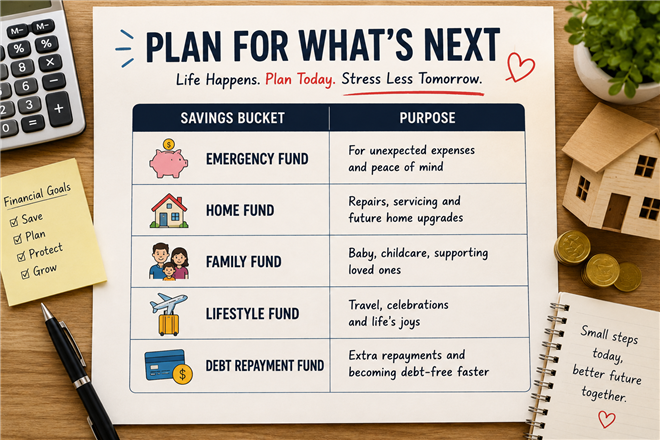
This keeps couples from using one pool of money for everything.
12. Borrowing Without a Clear Repayment Plan
Some couples may consider borrowing to manage renovation, furniture, or cashflow gaps. Borrowing is not automatically wrong, but it must be planned carefully.
The issue is borrowing out of panic, pressure, or comparison.
Before taking a loan, couples should understand:
- Why the loan is needed
- Whether the expense is urgent
- Total repayment amount
- Monthly instalment
- Interest and fees
- Repayment period
- Impact on household cashflow
- What happens if income drops
Borrowers should also be careful with loan offers received through SMS, calls, WhatsApp, Telegram, or social media. The Registry of Moneylenders states that licensed moneylenders are permitted to advertise only through business or consumer directories, their own websites, and advertisements placed within or on the exterior of their business premises.
How to avoid this mistake
Borrow only when:
- The need is genuine
- The lender is verified
- The contract is clear
- Repayment is affordable
- Both partners agree
- It does not create long-term financial stress
A loan should support your cashflow, not become the third person in your relationship.
13. Comparing Their Home With Everyone Else’s
Social media makes it easy to compare.
Someone else’s kitchen looks bigger. Someone else’s renovation looks more luxurious. Someone else bought designer furniture. Someone else has a walk-in wardrobe with lighting that looks like a K-drama dressing room.
But what you do not see is their budget, debt, income, family support, or repayment stress.
Comparison can push couples into unnecessary upgrades and lifestyle inflation.
How to avoid this mistake
Build a home that fits your life, not someone else’s feed.
Ask:
- Does this improve our daily living?
- Can we afford it comfortably?
- Are we buying this for ourselves or for other people to admire?
- Will we still feel good about this purchase six months later?
Your first home should feel peaceful. It does not need to perform for Instagram.
14. Forgetting to Maintain the Home Budget After Moving In
Many couples budget heavily during renovation, then stop tracking after moving in.
That is when lifestyle creep can happen.
Examples:
- More food delivery
- More furniture upgrades
- More subscriptions
- More shopping
- More hosting expenses
- More “small home things”
- More impulse buys
A home is never truly “done”. There will always be something to buy, improve, repair, or decorate.
How to avoid this mistake
Review your home budget once a month.
Track:
- Utilities
- Groceries
- Credit card bills
- Maintenance costs
- Loan repayments
- Insurance
- Savings
- Upcoming big expenses
If spending rises, adjust early. Small leaks are easier to fix before they become a flood.
A Simple First-Home Money Checklist for Couples
Before and after moving in, couples should check:
- Have we listed all move-in costs?
- Have we separated renovation needs from wants?
- Do we have an emergency fund?
- Do we know our monthly household bills?
- Have we agreed how to split expenses?
- Are we relying too much on credit cards?
- Are instalments still manageable?
- Have we reviewed insurance?
- Have we planned for future family expenses?
- Are we borrowing only if repayment is affordable?
This checklist can save couples from many expensive surprises.
Final Thoughts
Buying your first home is exciting, but it is also one of the biggest financial commitments young couples will make together.
The biggest mistake is not spending money. Spending is part of building a home. The real mistake is spending without a plan.
By budgeting properly, avoiding unnecessary debt, planning renovation carefully, protecting emergency savings, and speaking honestly about money, couples can enjoy their new home without turning it into a financial pressure cooker.
A beautiful home is not just about design. It is about peace, stability, and building a life together without quietly stressing over every bill.
That is the real renovation upgrade.