Credit cards are one of the most convenient financial tools available today. With rewards, cashback, and flexible spending, it’s easy to see why many Singaporeans rely on them for daily expenses.
However, convenience can quickly turn into a financial burden when balances are not paid in full. Over time, high interest rates can cause credit card debt to grow rapidly — often faster than expected.
This raises an important question:
Is it better to continue managing credit card debt, or switch to a consolidation loan?
Understanding the True Cost of Credit Card Debt
At first glance, credit card repayments may seem manageable. Many borrowers focus only on the minimum payment, which is typically a small percentage of the outstanding balance.
But this is where the problem begins.
Credit cards in Singapore commonly charge:
- Interest rates of 20% to 28% per annum
- Interest that compounds if balances are not fully paid
- Late fees and penalty charges
Over time, this creates a cycle where:
- A large portion of your payment goes towards interest
- The principal reduces very slowly
- Total repayment becomes significantly higher
This is why credit card debt is often considered one of the most expensive forms of borrowing.
What Is a Consolidation Loan?
A consolidation loan combines multiple debts into a single loan with a structured repayment plan.
Instead of juggling several credit card balances, you:
- Pay off all outstanding debts
- Replace them with one monthly instalment
- Benefit from a clearer repayment timeline
This simplifies your finances and makes it easier to stay in control.
Key Differences: Credit Card Debt vs Consolidation Loan
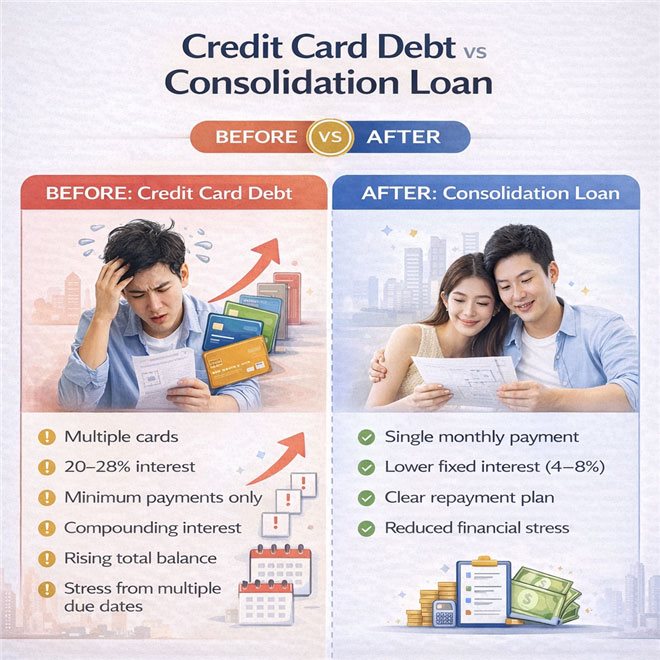
💳 Credit Card Debt
- High interest rates (20%+ per annum)
- Flexible repayment but easy to overspend
- Multiple payments across different cards
- No fixed timeline to clear debt
📉 Consolidation Loan
- Lower and more structured interest rates
- Fixed monthly repayment
- Clear loan tenure
- Helps reduce overall financial stress
Which Option Saves More Money?
In most cases, a consolidation loan saves more money over time, especially if you are carrying a large balance on your credit cards.
Why?
Because:
- Lower interest reduces total repayment
- Fixed tenure prevents prolonged debt
- You avoid compounding interest traps
However, the key is discipline. A consolidation loan works best when you avoid accumulating new credit card debt after consolidation.
When Should You Consider a Consolidation Loan?
You may want to consider this option if:
- You have multiple credit cards with outstanding balances
- You are only paying the minimum each month
- Your total interest payments are increasing
- You feel overwhelmed managing different debts
Recognising this early can help you take control before the situation escalates.
Beyond Numbers: The Psychological Benefit
Debt isn’t just financial — it’s emotional.
Many borrowers experience:
- Stress from multiple payment deadlines
- Anxiety over rising balances
- Lack of clarity on when debt will end
A consolidation loan simplifies everything into one clear plan. This alone can significantly improve peace of mind and financial confidence.
Responsible Borrowing Matters
While consolidation loans can be helpful, they are not a shortcut solution.
It’s important to:
- Adjust spending habits
- Avoid unnecessary new debt
- Stick to your repayment plan
Used responsibly, consolidation can be a powerful tool to reset your financial position.
Final Thoughts
Credit card debt can quietly grow into a major financial burden if left unmanaged. Understanding the true cost of interest and repayment is the first step towards making better financial decisions.
For borrowers looking to regain control, consolidation loans offer a structured and often more cost-effective alternative.
Some borrowers in Singapore choose to explore regulated options with licensed moneylenders such as Sands Credit, where repayment plans can be tailored to individual financial situations.
The goal is simple — reduce stress, improve clarity, and move towards financial stability.
📌 FAQ (Q&A) — Credit Card Debt vs Consolidation Loan in Singapore
Q: What is the main difference between credit card debt and a consolidation loan?
A: Credit card debt is revolving with high interest and flexible payments, while a consolidation loan combines your debts into one fixed repayment plan with a clearer timeline.
Q: Does a consolidation loan really save money?
A: In many cases, yes. A consolidation loan typically has a lower and more structured interest rate compared to credit cards, which helps reduce total interest paid over time.
Q: Will taking a consolidation loan affect my credit score?
A: Yes, but it can be positive if managed well. Making consistent repayments on time can improve your credit profile, while missed payments can negatively impact it.
Q: Can I still use my credit cards after consolidating my debt?
A: You can, but it is generally not advisable. Continuing to spend on credit cards after consolidation may lead to accumulating new debt on top of your existing loan.
Q: When should I consider a consolidation loan?
A: You should consider it if you:
- Have multiple credit card balances
- Are paying only minimum amounts monthly
- Feel overwhelmed by different repayment schedules
- Notice your interest charges increasing
Q: Is a consolidation loan suitable for small amounts of debt?
A: It depends. For smaller amounts, it may be manageable to repay directly. Consolidation is more beneficial when dealing with larger or multiple debts with high interest.
Q: Are consolidation loans only available from banks?
A: No. While banks offer debt consolidation plans, some borrowers also explore options with licensed moneylenders in Singapore, depending on their financial situation and flexibility needs.
Q: What is the biggest mistake people make after consolidating debt?
A: The biggest mistake is continuing to use credit cards excessively after consolidation. This creates a cycle of debt instead of resolving it.