When household expenses rise, most people focus on cutting costs immediately: spend less on food delivery, switch off lights, delay shopping, or compare utility plans. These are useful habits, but there is one financial safety net that matters even more during uncertain times — an emergency fund.
An emergency fund is money set aside specifically for unexpected situations. It is not for shopping, holidays, new gadgets, or “I deserve a treat” moments. It is the money that protects your household when life suddenly becomes expensive.
In 2026, having emergency savings is especially important for Singapore households. Living costs remain a concern, eligible HDB households are receiving support through U-Save and S&CC rebates, and household electricity tariffs increased by 17.0% before GST for July to September 2026 due to higher energy costs.
For families already managing housing, groceries, school fees, utility bills, insurance, transport, and loan repayments, even one unexpected bill can cause stress. That is why an emergency fund is not just a “nice to have”. It is one of the most practical parts of household financial planning.
What Is an Emergency Fund?
An emergency fund is a pool of savings reserved for urgent, unexpected, and necessary expenses.
Examples include:
- Sudden medical bills
- Urgent home repairs
- Job loss or income disruption
- Family emergencies
- Car or appliance breakdowns
- Temporary business cashflow issues
- Higher-than-usual utility bills
- Unexpected school or childcare costs
The key word is unexpected. A birthday celebration, National Day outing, year-end holiday, or sale purchase should not come from your emergency fund. Those are planned lifestyle expenses. Emergency savings are for situations that genuinely affect your household stability.
Think of it as your financial airbag. You hope you never need it, but if something happens, you will be very glad it is there.
Why Emergency Funds Matter More in 2026
Many Singapore households are feeling pressure from several directions at once. It is rarely one bill that causes financial stress. More often, it is the combination of higher utilities, food costs, family expenses, insurance premiums, credit card balances, and existing repayment commitments.
In July 2026, more than one million Singaporean HDB households received U-Save and S&CC rebates, including double the regular U-Save rebate for eligible households. These rebates provide useful support, but they do not replace the need for personal savings.
At the same time, SP Group announced that electricity tariffs for households increased by 17.0% before GST from 1 July to 30 September 2026, with the average monthly electricity bill for a family living in an HDB four-room flat expected to increase by S$17.14 before GST.
This is exactly why emergency funds are important. Government support can help reduce pressure, but households still need their own buffer for situations that rebates and vouchers cannot fully cover.
How Much Emergency Fund Should You Have?
MoneySense, Singapore’s national financial education programme, recommends setting aside 3 to 6 times your monthly expenses as emergency funds.
For most households, this is a good starting point. However, the right amount depends on your life stage, income stability, and family responsibilities.
Simple Emergency Fund Formula
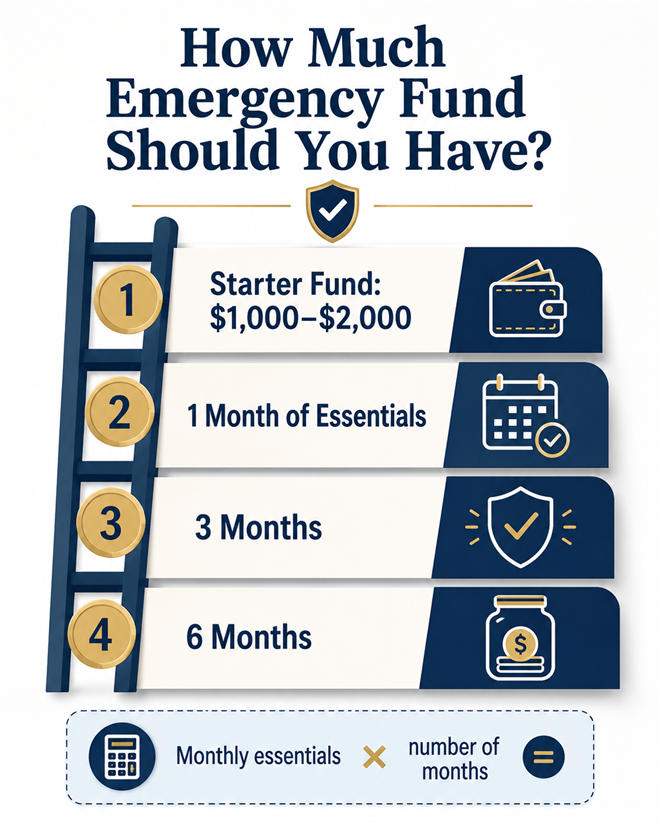
Monthly essential expenses × number of months = emergency fund target
For example:
| Monthly Essential Expenses |
3-Month Fund |
6-Month Fund |
| S$2,500 |
S$7,500 |
S$15,000 |
| S$4,000 |
S$12,000 |
S$24,000 |
| S$6,000 |
S$18,000 |
S$36,000 |
Essential expenses include things you must continue paying even during a difficult month: housing, utilities, groceries, transport, insurance, childcare, school needs, and minimum debt repayments.
Lifestyle spending, shopping, travel, dining out, and entertainment should not be included in your emergency fund calculation unless they are truly unavoidable. Your emergency fund is not meant to preserve your full lifestyle. It is meant to protect your household basics.
Who Needs a Larger Emergency Fund?
Not everyone needs the same amount of savings. A single person with stable income and low expenses may be comfortable with three months of essential expenses. A family with children, elderly parents, or variable income may need much more.
You may need a larger emergency fund if:
- You are the sole breadwinner
- You have children or dependants
- Your income is commission-based or irregular
- You are self-employed or run a business
- You have large housing or car commitments
- You support elderly parents
- You have ongoing medical needs
- You already have existing loans or credit card debt
For self-employed individuals and business owners, emergency savings are especially important because income may not arrive evenly every month. One slow month can quickly affect personal bills, business expenses, and household cashflow. Cashflow stress loves to multitask. Very rude of it.
What Counts as a Real Emergency?
One reason people struggle to build emergency savings is that the fund gets used for non-emergencies.
A real emergency is usually:
- Unexpected
- Necessary
- Urgent
- Difficult to delay
- Related to health, shelter, income, safety, or essential family needs
Real Emergencies
- Medical treatment not fully covered by insurance
- Urgent plumbing or electrical repairs
- Loss of income
- Essential appliance breakdown
- Family crisis requiring immediate travel
- Childcare disruption affecting work
Not Real Emergencies
- Concert tickets
- New phone upgrade
- Shopping sale
- Staycation
- Luxury item
- Wedding table upgrade
- “I just feel like buying it” spending
No judgement. We have all been personally victimised by a sale sign. But your emergency fund deserves boundaries.
Why Credit Cards Are Not an Emergency Fund
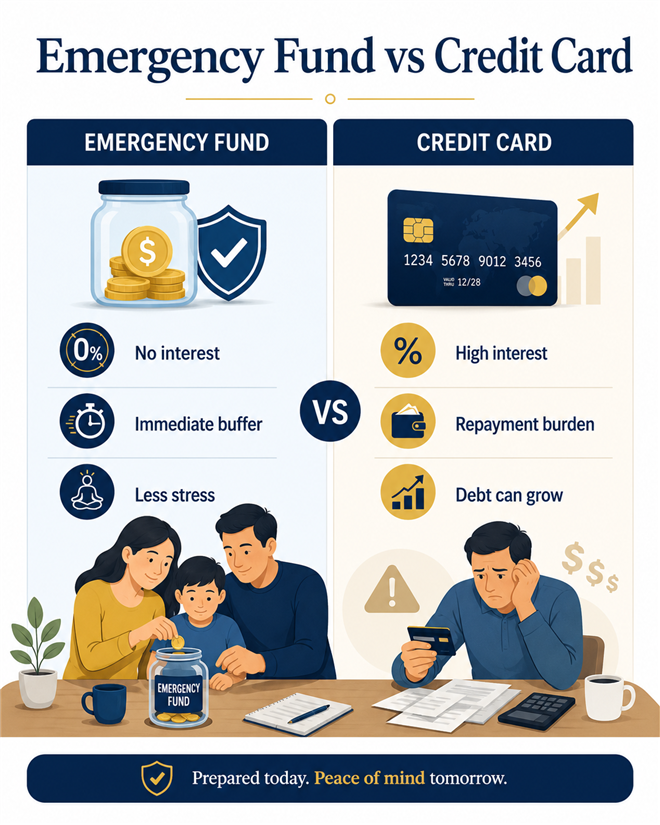
Some households rely on credit cards as a backup plan. While credit cards can be useful for short-term convenience, they are not the same as emergency savings.
The problem is that if you cannot pay the balance in full, interest charges can grow quickly. What started as a one-time emergency can become a long-term repayment burden.
Credit cards may help you pay first, but savings help you recover without adding debt.
Signs you are relying too much on credit cards include:
- Paying only the minimum amount
- Using one card to cover another bill
- Not knowing your total outstanding balance
- Using credit cards for groceries or utilities because cash is tight
- Feeling anxious when statements arrive
If your emergency plan is “use credit card first and worry later”, it may be time to build a proper cash buffer.
How to Build an Emergency Fund Step by Step
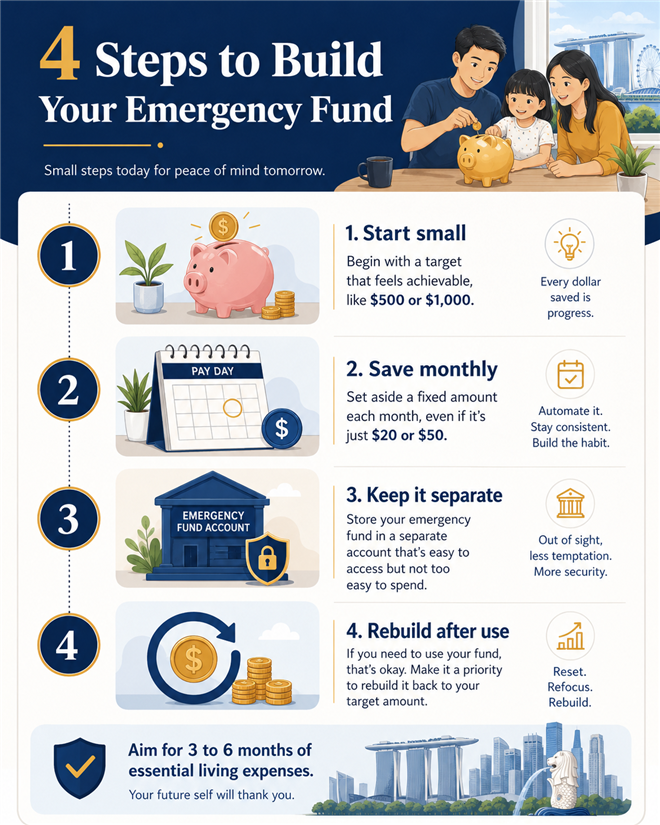
Building an emergency fund can feel intimidating, especially if your target is S$15,000, S$20,000, or more. The trick is not to focus only on the final number. Start with smaller milestones.
Step 1: Build a Starter Fund
Aim for your first S$1,000 to S$2,000.
This can help with smaller emergencies such as urgent repairs, medical co-payments, or temporary bill gaps.
Step 2: Save One Month of Essential Expenses
Once your starter fund is ready, work towards one month of essential expenses.
For example, if your household needs S$4,000 per month for essentials, your first major target is S$4,000.
Step 3: Build Towards Three Months
After one month, continue building towards three months. This gives you more breathing room if income is delayed or unexpected costs arrive.
Step 4: Work Towards Six Months or More
If you have dependants, unstable income, or higher commitments, aim for six months or more over time.
The goal is progress, not perfection. Even saving S$100 or S$200 per month is better than waiting until you can save a “perfect” amount.
Where Should You Keep Your Emergency Fund?
Emergency funds should be easy to access, low-risk, and separate from your daily spending account.
Good places to keep emergency savings include:
- A separate savings account
- A high-interest savings account
- A cash management account with reasonable liquidity
- A mix of immediate cash and slightly less immediate low-risk savings
Avoid placing your entire emergency fund in high-risk investments such as stocks, crypto, or volatile assets. Investments can fall in value exactly when you need money urgently.
A practical structure:
| Emergency Fund Layer |
Purpose |
| 1 month of expenses |
Immediate access in savings account |
| Next 2–3 months |
Separate savings or low-risk liquid account |
| Extra buffer |
Longer-term safe savings if suitable |
The money does not need to earn the highest possible return. Its job is to be there when needed. Your emergency fund is not trying to be an influencer. It does not need dramatic growth. It needs reliability.
How to Save When Your Budget Already Feels Tight
Many households know they should save, but after bills, groceries, utilities, insurance, and transport, there may not be much left.
Start by looking for small, repeatable savings.
1. Save First, Spend After
Set aside a fixed amount right after payday. Even S$50 or S$100 matters.
2. Use Rebates Wisely
If U-Save or S&CC rebates reduce your monthly bills, consider transferring the amount saved into your emergency fund if your cashflow allows. Eligible HDB households received U-Save and S&CC rebates in July 2026, and unused U-Save rebates can roll over to offset future utility bills.
3. Redirect Small Savings
If you cut one subscription, reduce food delivery, or spend less on transport, move the difference into savings immediately.
4. Use Windfalls Carefully
Bonuses, cash gifts, government payouts, and tax refunds can be split between savings, bills, and responsible spending.
5. Automate the Transfer
A recurring transfer makes saving less emotional. Your future self will thank you, probably with interest.
Emergency Fund vs Debt Repayment: Which Comes First?
This depends on your situation.
If you have no emergency savings at all, build a small starter fund first. Otherwise, one minor emergency may push you back into credit card debt or urgent borrowing.
After that, focus on high-interest debt while continuing small savings.
A balanced approach can look like this:
- Build S$1,000 to S$2,000 starter fund
- Pay down high-interest credit card debt
- Continue saving small amounts monthly
- Build towards one month of expenses
- Gradually expand to three to six months
If your debt repayment is already difficult, do not ignore it. Missing payments can create more stress and additional charges. Review your full cashflow early and consider speaking with your lender before the problem gets worse.
When Should You Use Your Emergency Fund?
Use your emergency fund when the expense is urgent, necessary, and cannot reasonably be delayed.
Before using it, ask:
1. Is this truly necessary?
2. Can it wait?
3. Is there a cheaper safe alternative?
4. Will this affect my household stability if unpaid?
5. Can I rebuild the amount after using it?
If the answer points to a real emergency, use the fund without guilt. That is what it is for.
After using it, start rebuilding as soon as possible. Even small top-ups help restore your safety net.
Emergency Fund for Families With Children
Families with children often need a larger buffer because unexpected costs can appear quickly.
Possible expenses include:
- Medical consultations
- School supplies
- Tuition changes
- Childcare fees
- Replacement uniforms or devices
- Transport changes
- Family helper needs
- Higher grocery costs
Parents may also need to take unpaid leave or reduce work temporarily if a child falls sick. This makes emergency savings even more valuable.
A good household approach is to have both:
- A general emergency fund
- A smaller child-related buffer for school, medical, or childcare surprises
This prevents every small family expense from becoming a crisis.
Emergency Fund for New Homeowners
New homeowners in Singapore often underestimate post-move-in expenses. Renovation, furniture, appliances, utility setup, defects, repairs, and moving costs can all happen close together.
If you recently collected keys or are preparing for your HDB TOP, your emergency fund should include a home buffer.
Useful categories:
Appliance repair or replacement
Plumbing and electrical issues
Air-con servicing
Furniture damage
Minor renovation rectification
Higher utility bills during move-in period
A new home should feel exciting, not like a surprise invoice factory.
Emergency Fund for Business Owners and Self-Employed Workers
If you are self-employed, a freelancer, commission-based worker, or business owner, your emergency fund should be larger than average.
Why?
Because income may fluctuate, client payments may delay, and business expenses may continue even when revenue slows.
You may need to separate:
- Personal emergency fund
- Business cash buffer
- Tax savings
- Supplier or rental buffer
- Staff salary buffer, if applicable
Mixing personal and business emergency savings can create confusion. Keep them separate where possible so you know exactly how much runway you have.
How Emergency Funds Reduce Borrowing Pressure
When cashflow is tight, some people search for fast loan Singapore, personal loan Singapore, urgent cash loan Singapore, or licensed moneylender Singapore.
There is nothing wrong with learning about financial options, but borrowing should not be the first response to every unexpected expense. An emergency fund reduces the need to borrow for small or medium-sized emergencies.
If borrowing is genuinely needed, it should be done carefully. The Registry of Moneylenders states that licensed moneylenders are only permitted to advertise through three channels: business or consumer directories, their own websites, and advertisements within or on the exterior of their business premises. Licensed moneylenders are not allowed to solicit loans through text messages, phone calls, or social media platforms.
Before taking any loan, borrowers should:
- Verify the lender on the Registry of Moneylenders
- Avoid unsolicited SMS, WhatsApp, Telegram, or social media loan offers
- Never transfer upfront fees to unknown parties
- Read the contract carefully
- Understand the total repayment amount
- Make sure repayment is affordable
A proper emergency fund gives you more time to decide calmly instead of borrowing under pressure.
A Practical Emergency Fund Plan for Singapore Households
Here is a simple example.
Assume a family’s essential monthly expenses are:
| Expense Category |
Monthly Amount |
| Housing |
S$1,800 |
| Utilities |
S$250 |
| Groceries |
S$900 |
| Transport |
S$400 |
| Insurance |
S$500 |
| Childcare / School |
S$700 |
| Loan Repayments |
S$600 |
| Other Essentials |
S$350 |
| Total Essentials |
S$5,500 |
Emergency fund targets:
| Target |
Amount |
| Starter fund |
S$1,000–S$2,000 |
| 1 month |
S$5,500 |
| 3 months |
S$16,500 |
| 6 months |
S$33,000 |
If this feels too high, start with the first milestone. Once you reach it, move to the next. Money confidence is built layer by layer, not one dramatic overnight transformation.
Common Emergency Fund Mistakes to Avoid
Mistake 1: Keeping It in the Same Spending Account
If your emergency fund sits beside your daily spending money, it is too easy to use it casually.
Mistake 2: Investing the Whole Fund
Emergency money should not be exposed fully to market risk.
Mistake 3: Saving Without Tracking Expenses
You need to know your essential monthly expenses before setting a realistic target.
Mistake 4: Using It for Lifestyle Spending
A sale is not an emergency. Neither is a spontaneous staycation. Painful truth, but somebody had to say it.
Mistake 5: Not Rebuilding After Using It
Once you use your emergency fund, make rebuilding it a priority.
Mistake 6: Waiting Until You Can Save a Big Amount
Small monthly savings are still powerful when done consistently.
Final Thoughts
An emergency fund is one of the most important financial tools for Singapore households in 2026. With rising utility costs, cost-of-living concerns, family commitments, and unexpected expenses, having savings set aside can make the difference between a temporary inconvenience and serious financial stress.
The goal is not to save perfectly. The goal is to build a buffer that gives your household options.
Start small. Save consistently. Keep the money separate. Use it only when truly needed. Then rebuild it after every withdrawal.
A strong emergency fund gives you something very valuable: breathing room. And in a year where household expenses can feel heavier, breathing room is priceless.