For many Singaporeans, payday feels good for about five minutes. Then the bills arrive, the groceries need topping up, the transport card wants attention, subscriptions renew quietly in the background, and somehow your salary starts behaving like it has somewhere else to be.
If you have ever looked at your bank account two weeks after payday and thought, “Where did everything go?”, you are not alone. The problem is not always reckless spending. Often, salary disappears because of many small, repeated money leaks that are easy to ignore.
In 2026, this matters even more. Singapore’s CPI-All Items inflation rose to 1.9% year-on-year in June 2026, while MAS Core Inflation rose to 1.6%, partly due to increases in food, services, and retail and other goods inflation. Even when inflation looks moderate on paper, households can still feel the pressure when several categories rise together.
At the same time, official household expenditure data shows that households spent an average of $5,931 a month on goods and services in 2023, with housing and related expenses, food, and transport making up the largest shares of spending.
This guide breaks down 10 common money leaks Singaporeans should check, how to spot them, and how to reduce them before they quietly drain your monthly income.
Why Your Salary Feels Like It Disappears Quickly
Many people assume money problems only happen when someone makes one big bad financial decision. But in real life, money often disappears through small daily choices.
A $7 drink. A $16 food delivery. A $28 subscription. A $42 private-hire ride. A $90 online cart. A $120 credit card instalment. None of these feel dramatic alone, but together they can turn your salary into a guest appearance.
This is why budgeting is not just about cutting enjoyment. It is about understanding patterns.
A good first step is to divide your spending into three groups:
| Category |
Examples |
| Must-pay Expenses |
Housing, utilities, groceries, transport, insurance, loan repayments |
| Adjustable expenses |
Dining out, subscriptions, shopping, private-hire rides, beauty services |
| Future expenses |
Emergency fund, year-end spending, medical needs, school fees, home repairs |
When your salary disappears fast, the issue is usually in the second and third categories: spending that can be adjusted, and future expenses that were not planned early enough.
1. Food Delivery and Dining Out Too Often
Food is one of the biggest everyday spending categories for many households. In Singapore, eating out is convenient, social, and honestly hard to resist. The problem starts when dining out and food delivery become the default.
In SingStat’s Household Expenditure Survey 2023 infographic, food was one of the top household spending categories, with selected monthly spending including $491 on hawker centres, food courts and coffee shops, $456 on food and non-alcoholic beverages, and $403 on restaurants, cafes and pubs.
The money leak usually comes from:
- Ordering delivery because of convenience
- Buying drinks or snacks daily
- Eating at restaurants too often
- Not planning meals before grocery shopping
- Wasting food at home
How to fix it
You do not need to stop eating out completely. That is not budgeting; that is emotional punishment.
Try this instead:
- Choose 2 to 3 fixed dine-out days per week
- Pack lunch once or twice a week
- Replace some delivery orders with supermarket-ready meals
- Keep quick meal options at home
- Set a weekly food budget instead of deciding meal by meal
A realistic change is better than an extreme one. If you usually order delivery five times a week, cutting it to three times already saves money.
2. Subscriptions You Forgot You Had
Subscriptions are the silent assassins of monthly cashflow.
They may include:
- Streaming platforms
- Music apps
- Cloud storage
- Fitness apps
- Beauty memberships
- Food delivery memberships
- Software tools
- Online learning platforms
- Mobile add-ons
- Gaming subscriptions
The danger is that each one feels small. But $9.99 here, $17.98 there, and $29.90 somewhere else can easily become $100 to $300 monthly.
How to fix it
Once a month, check your card and bank statements for recurring deductions.
Cancel anything you:
- Have not used in 30 days
- Forgot existed
- Can share legally within family plans
- Can pause temporarily
- Can replace with a cheaper alternative
A subscription should earn its place in your budget. If it is just sitting there collecting rent from your bank account, evict it.
3. Private-Hire Rides Becoming a Habit
Private-hire rides are useful when you are rushing, carrying heavy items, travelling late, or dealing with family needs. But when they become the default option, transport costs can rise quickly.
SingStat’s HES 2023 infographic shows that transport was one of the largest household spending categories, and selected transport spending included $678 on private road transport, $174 on public road transport, and $93 on passenger transport by air.
A few private-hire rides a week can easily cost more than a monthly public transport routine.
How to fix it
Try these:
- Set a monthly private-hire budget
- Use MRT or bus for predictable routes
- Avoid peak-hour rides where possible
- Leave earlier to reduce “late already, just Grab” moments
- Use private-hire only for genuinely useful situations
Convenience is not bad. But convenience without limits can become expensive very fast.
4. Credit Card Spending Without a Repayment Plan
Credit cards are useful when paid in full every month. They become a money leak when balances roll over.
Credit card problems usually start small:
- Paying only the minimum amount
- Using instalments for non-essential purchases
- Not tracking total outstanding balance
- Spending because points or cashback feel rewarding
- Treating credit limit as available money
The real issue is not the card itself. It is using tomorrow’s income to pay for today’s lifestyle.
How to fix it
Before using your credit card, ask:
- Can I pay this in full by the due date?
- Is this a need or a want?
- Am I already carrying a balance?
- Will this affect next month’s cashflow?
If you already have credit card debt, stop adding new non-essential spending first. Then focus on repayment, starting with the highest-interest balance or the smallest balance you can clear quickly.
A cashback reward is nice. But if you pay interest, the bank is not giving you a gift. It is giving you a tiny biscuit while taking the whole cake.
5. Too Many Instalment Plans
Instalment plans make spending feel lighter because the monthly payment looks manageable. The problem is when too many small instalments stack up.
Common instalments include:
- Furniture
- Electronics
- Phones
- Appliances
- Renovation items
- Beauty packages
- Travel bookings
- Buy-now-pay-later purchases
- Credit card instalments
One instalment may be fine. Five instalments at once can make your salary feel pre-booked before payday even arrives.
How to fix it
List every instalment plan you currently have.
Include:
.jpg)
Then ask:
- Which instalments end soon?
- Which can be paid off early?
- Which should never be repeated?
- Is my total instalment amount too high compared with income?
A good rule is to avoid new instalments until existing ones are cleared.
6. Lifestyle Upgrades After Pay Raises
A salary increase should improve your financial position, but many people accidentally increase spending at the same time.
This is called lifestyle inflation.
It can look like:
- Better restaurants
- More shopping
- Higher-end gym or beauty memberships
- More private-hire rides
- More holidays
- More expensive gifts
- Upgraded phone plans
- Bigger credit card bills
MOM’s income statistics show that the median gross monthly income from employment of full-time employed residents, including employer or platform operator CPF contributions, was $5,775 in 2025, up from $5,500 in 2024. Income may rise, but if spending rises just as quickly, the extra salary does not turn into savings.
How to fix it
When income increases, split the increase before lifestyle spending gets to it.
For example:
| Salary Increase |
Suggested Split |
| 50% |
Savings / emergency fund |
| 30% |
Debt repayment or future goals |
| 20% |
Lifestyle upgrade |
This lets you enjoy some of your progress while still building a stronger financial base.
Celebrate the raise, yes. But do not let your expenses throw a bigger party than you.
7. Not Planning for Irregular Expenses
Some expenses do not happen every month, but they still happen regularly enough to plan for.
Examples include:
- Insurance premiums
- Road tax
- Car servicing
- Medical and dental appointments
- Home repairs
- Gifts and celebrations
- School expenses
- Festive spending
- Travel
- Pet care
- Appliance replacement
When these are not planned, they feel like emergencies. Then people may rely on credit cards, savings meant for other goals, or last-minute borrowing.
How to fix it
Create sinking funds.
A sinking fund is money set aside monthly for expected future expenses.
Example:
| Future Expense |
Estimated Cost |
Monthly Savings |
| Insurance premium |
$1,200 yearly |
$100/month |
| Year-end gifts |
$600 |
$100/month for 6 months |
| Home repairs |
$1,000 |
$100/month for 10 months |
| School expenses |
$500 |
$100/month for 5 months |
The amount does not need to be perfect. The point is to stop predictable expenses from becoming fake emergencies.
8. Grocery Shopping Without a Plan
Groceries can leak money because they happen often. A few extra items each trip can add up fast.
Common grocery leaks include:
- Shopping while hungry
- Buying duplicates because you did not check the fridge
- Throwing away expired food
- Buying too many snacks
- Choosing convenience items too often
- Ignoring unit prices
- Not planning meals
How to fix it
Before shopping:
- Check what you already have
- Plan 3 to 5 meals
- Write a list
- Set a spending limit
- Buy staples first
- Keep impulse snacks controlled
Useful staples include rice, noodles, eggs, tofu, frozen vegetables, canned tuna, oats, beans, and affordable proteins.
The goal is not to become a supermarket monk. It is to shop with a plan so the receipt does not jump-scare you.
9. Small Online Purchases That Add Up
Online shopping makes spending almost too easy. A few taps and your money leaves quietly, sometimes before your brain gets involved.
Common online money leaks:
- Sale purchases
- Shopee or Lazada impulse buys
- TikTok Shop temptation
- Small gadgets
- Beauty items
- Clothes
- Home décor
- “Free shipping if you spend more” traps
The dangerous part is that small purchases feel harmless. But $12, $18, $25, and $39 orders add up over the month.
How to fix it
Use a 24-hour waiting rule.
For non-essential purchases:
- Add to cart
- Wait 24 hours
- Recheck your budget
- Buy only if you still want it and can afford it
For bigger purchases, wait 3 days.
Also, delete saved card details if you need more friction. Make your impulse spending work harder. It has been too comfortable.
10. Borrowing to Cover Spending Instead of Fixing the Pattern
When salary disappears quickly, some people search for terms such as fast loan Singapore, personal loan Singapore, urgent cash loan, or licensed moneylender Singapore.
Borrowing may help in genuine short-term situations, but it should not be used to support repeated overspending. If the root problem is recurring money leaks, a loan may only delay the stress.
Licensed moneylenders in Singapore are also subject to strict advertising rules. The Registry of Moneylenders states that licensed moneylenders may advertise only through business or consumer directories, their own websites, and advertisements placed within or on the exterior of their business premises.
How to fix it
Before borrowing, ask:
- Is this expense urgent and necessary?
- Have I reviewed my spending leaks first?
- Can I repay comfortably?
- What is the full repayment amount?
- Is the lender verified on the official Registry of Moneylenders?
- Am I responding to an unsolicited loan message?
A responsible loan decision should be calm, clear, and affordable. It should not feel rushed, secretive, or confusing.
A Simple Salary Leak Checklist
Use this checklist before the next payday:
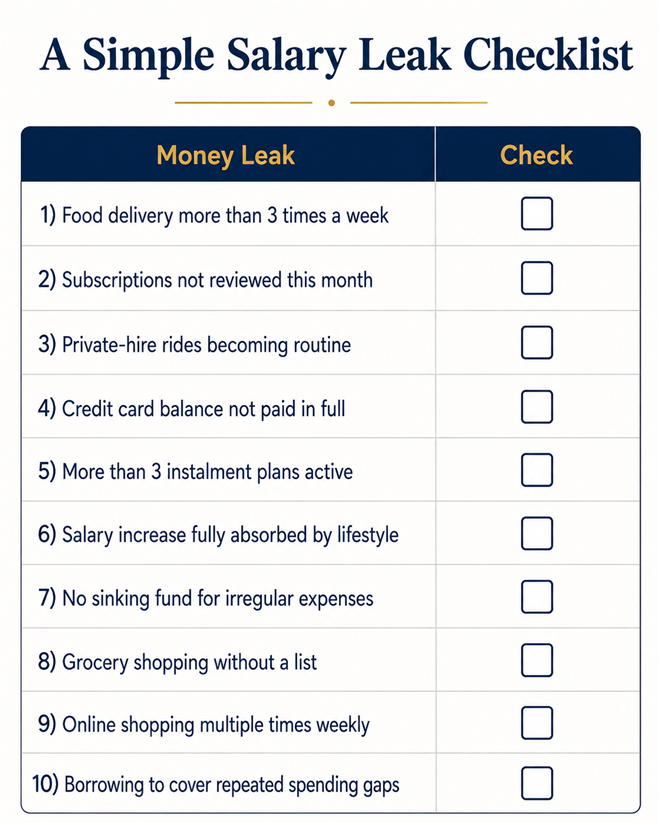
If you tick several boxes, do not panic. It simply means you have found the leaks. Now you can start plugging them.
What to Do This Week
Start with one small action from each category:
Today
Review your last 30 days of bank and card transactions.
This week
Cancel one unused subscription and set a food delivery budget.
This payday
Transfer a fixed amount into savings immediately.
This month
List all instalments, debts, and irregular expenses.
Before borrowing
Check whether the problem is a one-time cashflow gap or a repeated spending pattern.
Small steps are boring until they work. Then suddenly they become genius.
Final Thoughts
If your salary disappears quickly, it does not always mean you are careless with money. It often means your spending system needs a reset.
Food delivery, subscriptions, transport, credit card balances, instalment plans, online shopping, grocery habits, and unplanned future expenses can quietly drain your income. The good news is that once you can see the leaks, you can control them.
Start simple. Track your spending. Cut what you do not use. Plan irregular costs. Keep some joy in your budget, but do not let convenience and impulse spending run the show.
Your salary should not vanish mysteriously every month. It should have a job, a plan, and maybe a little respect for your future self.