For many Singapore families, school expenses do not only happen at the start of the year. They continue quietly throughout the year through transport, meals, tuition, enrichment classes, uniforms, stationery, assessment books, digital learning tools, CCA needs, school activities, and exam preparation.
By July, many parents are already feeling the second-half-of-the-year squeeze. The June holidays are over, Term 3 has started, National Day plans are around the corner, and Term 4 will arrive quickly after the September break. For MOE schools, Term 3 in 2026 runs from 29 June to 4 September, making July a practical time for families to review school-related spending before the final stretch of the academic year.
The challenge is that school costs often feel “small” individually. A few dollars for meals, transport top-ups, extra practice books, printing, CCA items, tuition fees, and weekend enrichment may not seem alarming at first. But when added together, these costs can become a real monthly pressure point.
This guide helps Singapore parents prepare for school expenses, manage household cashflow, reduce financial stress, and avoid relying too heavily on credit cards or short-term borrowing.
Why School Expenses Can Strain Family Budgets
School-related spending is tricky because it is both recurring and unpredictable.
Some costs are expected every month, such as meals, transport, tuition, or student care. Others appear suddenly, such as replacement uniforms, lost water bottles, CCA equipment, excursion payments, exam preparation materials, or last-minute project supplies.
Parents may also be managing other household costs at the same time:
- Groceries
- Utility bills
- Mortgage or rent
- Insurance premiums
- Transport
- Medical expenses
- Loan repayments
- Credit card bills
- Childcare or eldercare responsibilities
This is why school expenses should be treated as a proper monthly budget category, not a random “pay when needed” item. Random payments are cute until they start attacking your bank balance in groups.
1. Start With a Monthly School Expense List
The first step is to write down what you usually spend on each child every month.
A simple school expense list may include:
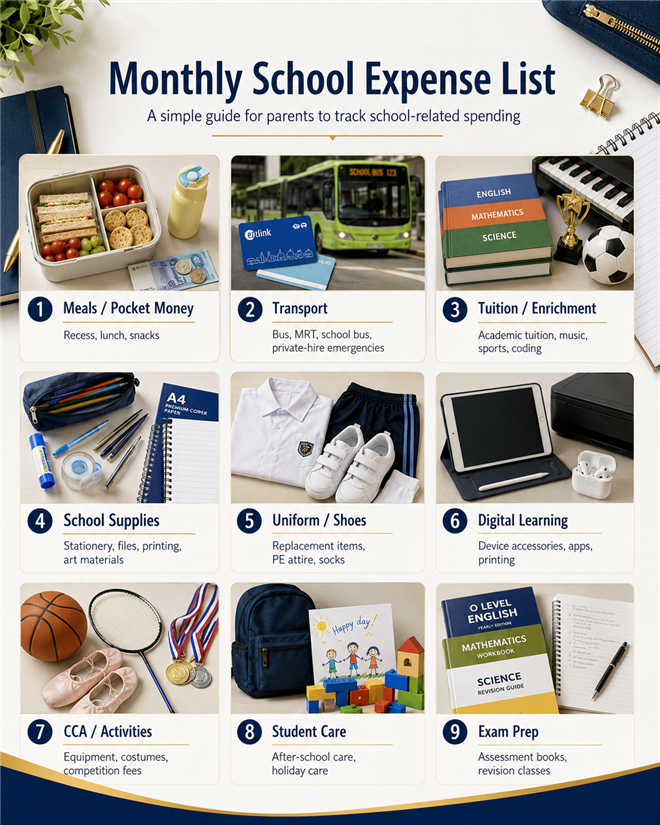
Once you see the full list, it becomes easier to identify which costs are essential, which are adjustable, and which are “nice-to-have but maybe not this month”.
2. Set a Realistic Pocket Money Budget
Pocket money is one of the most common school-related expenses, especially for primary and secondary school students.
Instead of deciding randomly, set an amount based on:
- Age of child
- School meal prices
- Transport needs
- Number of school days
- Whether lunch is eaten in school
- Whether the child has CCA days
- Family budget comfort level
A simple structure could be:
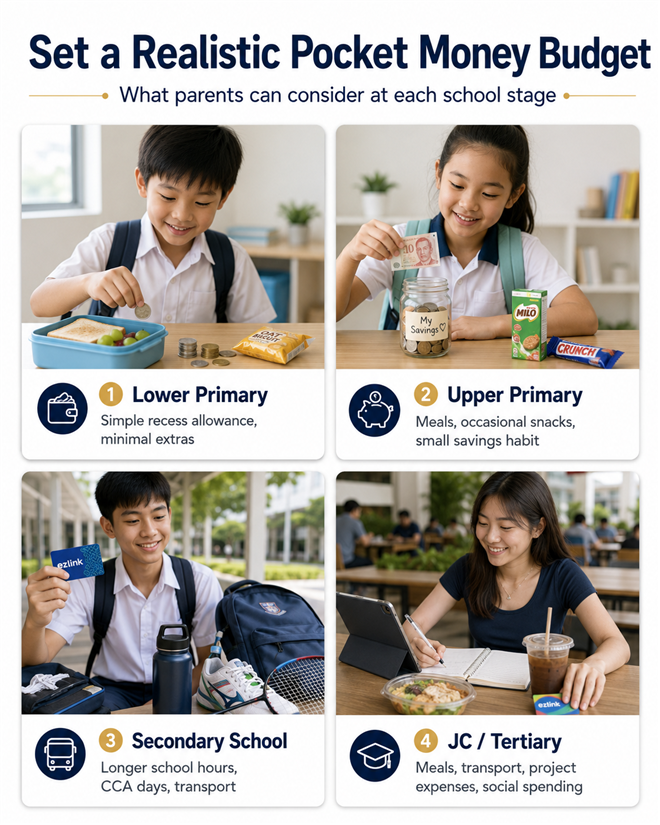
Parents can also use pocket money to teach budgeting. For example, give a weekly amount instead of daily cash so children learn to plan across several days.
This does not mean turning your child into a mini accountant at age nine. But a little money awareness early can prevent big “I spent everything by Tuesday” energy later.
3. Watch Transport Costs Closely
Transport costs can vary widely depending on where the school is, how often your child travels, and whether they use public transport, school bus, or private arrangements.
If your child takes public transport, monitor top-ups and concession usage. If your child takes a school bus, review whether the cost still makes sense compared with schedule convenience and safety.
For families receiving MOE financial assistance, public transport subsidy support was increased to S$21 per month from 2026 for eligible primary and secondary students taking public transport.
Practical tips:
- Top up transport cards on a fixed schedule
- Review monthly transport spending
- Avoid frequent last-minute private-hire rides
- Plan routes for CCA days
- Check whether siblings can travel together safely
- Ask the school about available support if transport cost becomes difficult
Transport is one of those costs that can quietly grow when mornings become chaotic. The “late already, just Grab” habit is very dangerous. Convenient, yes. Budget-friendly, absolutely not.
4. Separate Essential School Supplies From “Extra” Purchases
School supplies can easily become over-shopping.
Essential supplies include:
- Pens and pencils
- Correction tape
- Notebooks
- Files
- Calculator, if needed
- Art materials
- Name labels
- School-approved items
Extra purchases may include:
- Multiple cute pencil cases
- Branded water bottles
- Fancy stationery sets
- Expensive bags when the current one still works
- Non-required assessment books
- Trend-based items
Parents can save by keeping a home “school supply box” with commonly used items. Before buying more, check what is already available at home.
A good rule: buy what supports learning, not what supports the stationery aisle’s retirement plan.
5. Review Tuition and Enrichment Spending
Tuition and enrichment can be helpful, but they can also become one of the biggest monthly expenses for families.
Before committing to another class, ask:
- Is my child genuinely benefiting from this?
- Is the class addressing a real need?
- Can school-based support help first?
- Is this for my child’s growth, or my anxiety?
- Can we reduce frequency instead of stopping completely?
- Are we overloading the child’s schedule?
For exam years, tuition spending often increases because parents want to give their children extra support. That is understandable. But more classes do not always mean better results. Sometimes the child needs better rest, clearer study structure, or targeted help rather than another weekly lesson.
This is where parents need to be lovingly ruthless. Not every enrichment class deserves your GIRO details.
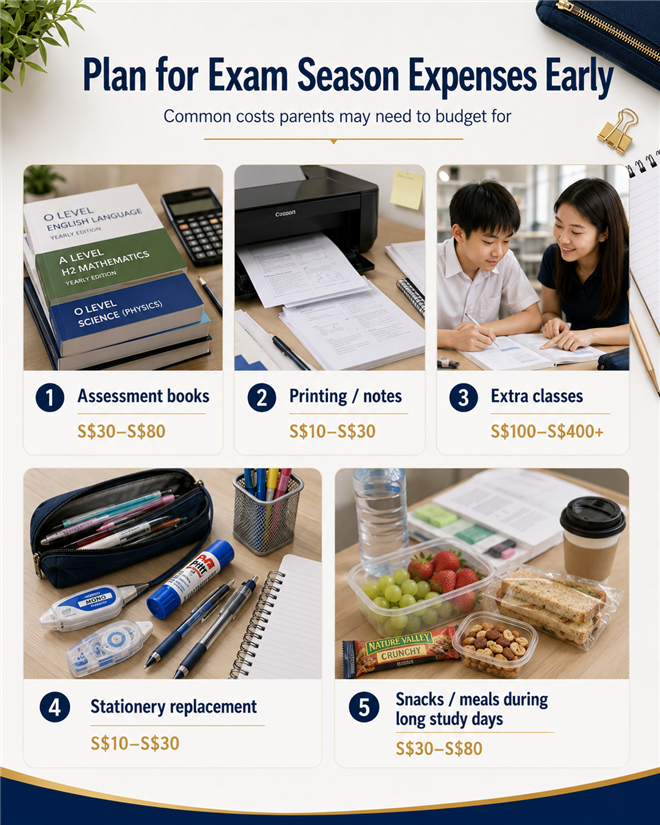
6. Plan for Exam Season Expenses Early
The second half of the school year can bring more revision, tests, preliminary exams, practical assessments, and final exams depending on the child’s level.
Common exam-season expenses include:
- Assessment books
- Revision workshops
- Printing notes
- Extra tuition sessions
- Study snacks
- Transport to classes
- Online learning subscriptions
- Replacement stationery and calculators
Instead of buying everything at once, create an exam preparation budget.
Example:
Parents do not need to overspend to support exam preparation. The most important thing is to target the child’s weakest areas and avoid buying materials that end up untouched. Unused assessment books are basically expensive paperweights with guilt attached.
7. Budget for CCA and School Activities
CCA and school activities can create hidden costs, especially if your child participates in sports, performing arts, competitions, camps, or overseas programmes.
Possible expenses include:
- Sports shoes
- Instruments
- Costumes
- Training gear
- Competition fees
- Camp items
- Additional meals
- Transport
- Replacement equipment
Ask your child early about upcoming activities. Many students only mention payment forms when the deadline is “tomorrow”. Classic student behaviour. Parents everywhere deserve compensation for emotional damage.
A simple monthly CCA buffer of S$20 to S$50 per child can help reduce surprise payments.
8. Use Financial Assistance Schemes Early If Needed
Families who are struggling should not wait until school expenses become overwhelming. Singapore has school-related financial assistance schemes to help eligible students with education costs.
From Academic Year 2026, MOE revised the income eligibility criteria and raised support for several financial assistance schemes, with the changes expected to benefit an additional 31,000 students. MOE also introduced the HOMES means-testing process from AY2026 to streamline applications and income assessment.
For the MOE Financial Assistance Scheme, published 2026 materials state that eligible students may receive support such as school and miscellaneous fee subsidies, textbooks, school attire, transport subsidies, and school meal subsidies, depending on education level and eligibility.
Parents can check with the school’s General Office, form teacher, or school website for the latest application process. If your financial situation changes mid-year due to job loss, income reduction, illness, or family emergency, it is worth asking the school what support is available.
Seeking help early is not embarrassing. Struggling quietly until everything snowballs is the expensive part.
9. Teach Children the Difference Between Needs and Wants
School is also a good place for children to learn financial habits.
You can teach children to separate:
Needs
Meals, transport, school supplies, basic uniform, required books.
Wants
Extra snacks, trendy items, expensive stationery, unnecessary upgrades, impulse purchases.
Practical ways to teach money habits:
- Give weekly pocket money instead of daily pocket money
- Encourage saving a small amount each week
- Let older children track spending
- Explain why some purchases must wait
- Set rules for online purchases or in-app spending
- Give children a small budget for school supplies and let them choose within it
The goal is not to make children anxious about money. The goal is to help them understand that money choices have trade-offs.
A child who learns to budget for snacks today may become an adult who does not panic-buy everything during sales. We love character development.
10. Avoid Using Credit Cards for School Costs Without a Repayment Plan
Credit cards can be useful for convenience, especially when paying for books, supplies, transport top-ups, or online learning subscriptions.
The problem begins when school-related costs are added to an existing balance and not paid in full.
Warning signs include:
- Paying only the minimum credit card amount
- Using cards for routine school expenses because cash is tight
- Not knowing the total outstanding balance
- Using one credit card to pay another bill
- Feeling stressed when school payment forms arrive
- Relying on buy-now-pay-later for children’s essentials
If school expenses are causing cashflow strain, pause and review the full household budget. Cut non-urgent spending first. Consider whether tuition, enrichment, shopping, or dining expenses can be adjusted.
Borrowing should never be the first response to recurring school costs. If financial support is genuinely needed, families should compare options carefully, understand total repayment costs, and work only with regulated financial providers.
11. Prepare for the Year-End School Spending Cycle
Even though this article focuses on July and the second half of the year, parents should already think ahead to year-end.
Year-end school costs may include:
- New school books
- New uniforms
- School shoes
- Bags
- Stationery
- Transport arrangements
- Student care changes
- Secondary school transition costs
- JC / poly / ITE preparation costs
- Holiday programmes
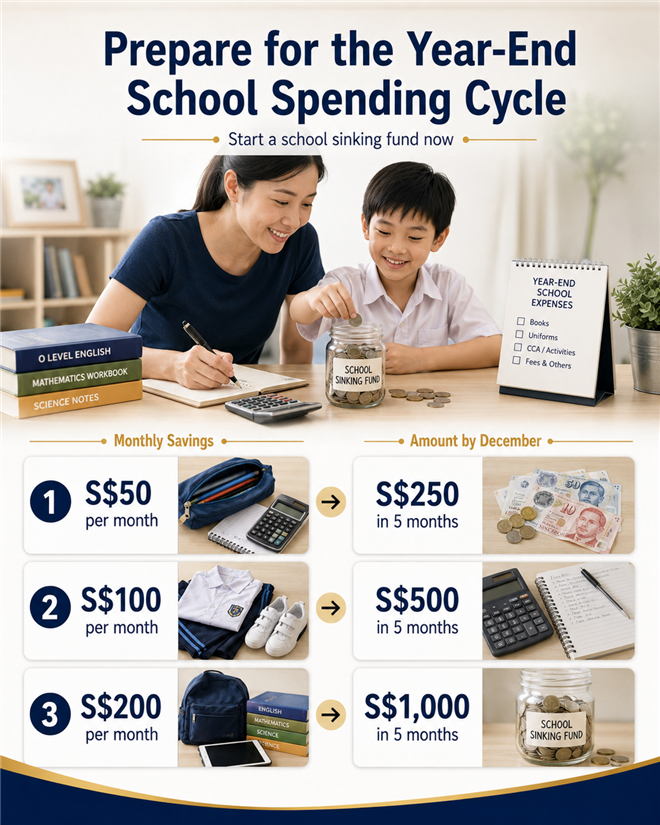
A practical method is to start a “school sinking fund” now.
For example:
This makes year-end spending less painful because the money is already prepared. Future-you will be very proud. Present-you may roll eyes a bit, but he/she will survive.
12. Create a Back-to-School Budget Template
Here is a simple template parents can use:
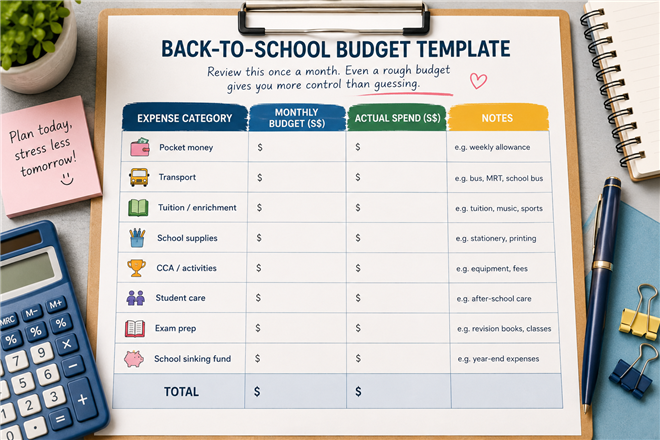
Review this once a month. It does not need to be perfect. Even a rough budget gives you more control than guessing.
What Parents Can Do This Week
If you want to act immediately, start with these five steps:
- List every school-related expense for each child
- Set a weekly pocket money amount
- Check transport card top-ups or school bus costs
- Review tuition and enrichment commitments
- Start a small year-end school fund
Small actions now can prevent a stressful December later.
Final Thoughts
Back-to-school expenses are not just a January problem. For Singapore families, school costs continue throughout the year, especially in the second half when exam preparation, CCA commitments, transport, meals, tuition, and year-end planning all come together.
The key is not to cut every expense. The key is to plan intentionally.
When parents understand their school-related costs, they can make calmer decisions, avoid unnecessary credit card debt, use financial assistance where eligible, and prepare earlier for upcoming expenses.
A strong school budget does more than protect money. It protects peace of mind — and honestly, parents deserve every bit of peace they can get.