National Day is one of the most meaningful times of the year in Singapore. It is a season of red-and-white outfits, family meals, fireworks, heartland pride, long weekend plans, shopping promotions, and that very Singaporean feeling of “just celebrate first lah”.
In 2026, National Day fell on Sunday, 9 August, and Monday, 10 August 2026 was a public holiday, giving many Singaporeans a longer weekend to celebrate, eat out, shop, travel around, or spend time with family and friends.
NDP 2026 also carried extra excitement because Singapore turned 61, and the National Day Parade returned to the National Stadium for a major celebration.
But after the celebrations, there is often another event nobody bought tickets for: the post-long-weekend budget reality check.
Maybe the meals cost more than expected. Maybe Grab rides added up. Maybe the “small” shopping deals were not so small. Maybe your credit card was swiped so often it started building a personality. Whatever happened, the important thing is not to panic. The important thing is to reset early before August spending turns into September stress.
This guide explains how Singaporeans can recover from National Day spending, reset their household budget, manage credit card bills, and avoid unnecessary debt before the year-end season arrives.
Why Long Weekend Spending Can Get Out of Control
A long weekend can feel harmless because it is only a few days. But spending can add up quickly when several activities happen close together.
Common National Day weekend expenses include:
| Spending Area |
Examples |
| Food and drinks |
Family meals, cafes, food delivery, snacks, drinks |
| Transport |
Private-hire rides, taxis, parking, petrol |
| Shopping |
National Day sales, online deals, clothes, gadgets |
| Family activities |
Attractions, movies, outings, children’s activities |
| Celebration items |
Red-and-white outfits, picnic supplies, decorations |
| Credit card spending |
Dining, online purchases, instalments, impulse buys |
The issue is usually not one huge purchase. It is the combination of many smaller expenses that quietly join forces like a very organised financial gang.
A $38 lunch, $22 ride, $18 bubble tea and snacks, $79 online order, $120 family dinner, and $60 activity can turn a simple weekend into a few hundred dollars of spending before you even realise it.
1. Check What You Actually Spent
The first step is to stop guessing.
Open your bank app, credit card app, e-wallet transactions, and receipts. Look at what you spent from 8 to 10 August, and include anything purchased slightly before the weekend for National Day plans.
Create a simple spending summary:
| Category |
Amount Spent |
| Dining / food delivery |
S$ |
| Transport |
S$ |
| Shopping |
S$ |
| Family activities |
S$ |
| Groceries / picnic items |
S$ |
| Credit card instalments |
S$ |
| Other spending |
S$ |
| Total |
S$ |
This may feel uncomfortable, but it gives you control. A budget reset starts with facts, not vibes.
Once you see the total, ask yourself:
- Which expenses were planned?
- Which expenses were impulse spending?
- Which expenses were worth it?
- Which expenses would I avoid next time?
- Did I use credit cards more than expected?
The goal is not to punish yourself. The goal is to understand where the money went so it does not keep disappearing like a magician with bad intentions.
2. Separate Meaningful Spending From Regret Spending
Not all spending is bad. Some expenses may have created real memories with family or friends. Others may have been unnecessary, emotional, or triggered by promotions.
Separate your spending into two groups:
| Types of spending |
Examples |
| Meaningful spending |
Family meal, outing with children, planned gathering, reasonable celebration |
| Regret spending |
Impulse shopping, unnecessary upgrades, expensive transport due to poor planning, unused items |
This helps you reset without guilt.
For example, a family dinner may have been worth it. But buying three random sale items online at midnight because “National Day deal” may not have been your finest financial moment. It happens. The cart was loud, you were weak, we move on.
Once you identify regret spending, write down one rule for next time.
Examples:
- No shopping during festive sales without a 24-hour waiting rule
- Set transport budget before going out
- Eat before shopping
- Choose one special meal, not three expensive meals
- Use cash or debit for outings instead of credit cards
This turns spending regret into useful data.
3. Review Your Credit Card Bill Before It Snowballs
If you used your credit card during the long weekend, check the outstanding balance early. Do not wait until the statement arrives and greets you like a villain.
MoneySense explains that when a credit card bill is paid in full and on time, interest is not charged. But if the bill is not paid in full, interest and charges may apply, and minimum payments generally go towards interest charges first before reducing the outstanding balance.
Check these details:
| What to Check |
Why It Matters |
| Total outstanding balance |
Shows how much you owe |
| Payment due date |
Helps avoid late fees |
| Minimum payment |
Shows the least required payment |
| Interest charges |
Shows whether debt is already rolling |
| Instalment plans |
Shows future monthly commitments |
| New transactions |
Shows where the spending came from |
If you can pay the full balance, do so before the due date. If you cannot, pay more than the minimum where possible and stop adding new non-essential spending to the card.
Credit cards are useful tools when managed well. But if balances roll over month after month, they can quickly become expensive.
4. Pause Non-Essential Spending for 7 Days
After a spending-heavy weekend, give your budget a short cooling-off period.
For the next 7 days, pause:
- Online shopping
- Food delivery
- Non-essential beauty services
- Extra cafe visits
- Private-hire rides unless necessary
- New instalment purchases
- Unplanned entertainment spending
This is not forever. It is just a short reset.
A 7-day pause gives your cashflow time to breathe. Think of it as putting your wallet in a little spa retreat. No drama, just recovery.
During this pause, focus on essentials:
| Essential Area |
What to Do |
| Groceries |
Cook simple meals or use what is already at home |
| Transport |
Use MRT or bus for routine travel |
| Bills |
Pay urgent bills first |
| Debt |
Set aside money for credit card repayment |
| Savings |
Keep a small emergency buffer if possible |
A short pause can prevent a festive spending mood from becoming a full-month spending pattern.
5. Build a Post-National Day Budget Reset
Now create a simple August reset budget.
Start with what is left for the month. Then allocate money to the most important categories first.
The key is to give credit card repayment and essential bills priority before lifestyle spending.
This is especially important if the long weekend spending was higher than expected. If you keep spending normally after an expensive weekend, August can become very tight by the third week.
And nobody wants to reach payday week surviving on instant noodles and emotional support.
6. Use Any August Payouts Wisely
Some eligible Singaporeans may receive GSTV – Cash in August 2026. MOF announced that about 1.5 million eligible adult Singaporeans would receive up to S$850 in GSTV – Cash, while about 710,000 eligible seniors would receive up to S$450 in MediSave top-ups.
If you receive a payout, avoid treating it as bonus spending money if your National Day weekend already stretched your budget.
A practical allocation could look like this:
| Use |
Suggested Allocation |
| Credit card repayment |
S$150–S$400 |
| Groceries / daily essentials |
S$100–S$250 |
| Utility bills |
S$100–S$200 |
| Emergency fund |
S$100–S$300 |
| Small treat |
S$30–S$80 |
The exact split depends on your situation. But the principle is simple:
Reduce financial pressure first. Enjoy what is left after the important things are covered.
A payout can give breathing room, but only if it is used intentionally.
7. Cut Back on the Spending Category That Caused the Most Damage
Look at your long weekend spending summary. Which category was the biggest?
Once you know the main cause, choose one practical reset action.
| Biggest Spending Area |
Budget Reset Action |
| Dining out |
Set a weekly dining limit |
| Food delivery |
Limit delivery to fixed days |
| Shopping |
Use a 24-hour waiting rule |
| Transport |
Use public transport for routine trips |
| Family activities |
Choose free or low-cost activities for the next two weekends |
| Credit card spending |
Stop non-essential card usage for 30 days |
| Instalments |
Avoid new instalment plans |
Do not try to fix everything at once. Start with the biggest leak.
For many households, one spending category does most of the damage. Fixing that one category can make the rest of the month much easier.
8. Avoid New Instalment Plans After a Spending Weekend
Instalments can feel harmless because the monthly amount looks small. But after an expensive weekend, adding new instalments can make future cashflow tighter.
Be careful with instalments for:
- Phones
- Gadgets
- Furniture
- Appliances
- Travel bookings
- Beauty packages
- Online purchases
- Buy-now-pay-later spending
MoneySense notes that instalment payment plans can carry hidden costs, default risks, and fees, and even interest-free credit card instalment plans can become costly if payments are missed and credit card interest charges apply.
Before taking any new instalment plan, ask:
| Question |
Why It Matters |
| Do I need this now? |
Avoids emotional spending |
| Can I pay in full instead? |
Reduces future commitments |
| How many instalments do I already have? |
Prevents cashflow strain |
| What is the total cost? |
Shows the real amount paid |
| Will this affect bills next month? |
Protects future cashflow |
A small monthly payment can still become a big problem if several instalments stack together.
9. Plan Cheaper Weekends for the Rest of August
A budget reset does not mean staying home sadly and staring at the wall. You can still enjoy the rest of August without overspending.
Low-cost weekend ideas:
- Picnic at a park
- Home movie night
- Potluck with friends
- Free neighbourhood events
- Walk around Marina Bay, East Coast Park, or Botanic Gardens
- Cook a themed dinner at home
- Visit the library
- Use existing attraction memberships or vouchers
- Do a no-spend weekend challenge
The trick is to plan activities before the weekend arrives.
If you leave plans until the last minute, you are more likely to spend on convenience: private-hire rides, expensive meals, impulse shopping, and “since we are already here” purchases.
That phrase has caused more financial damage than some people’s exes.
10. Do Not Borrow Just to Cover Celebration Spending
After a spending-heavy weekend, some people may look for fast cash solutions. They may search for terms such as fast loan Singapore, personal loan Singapore, urgent cash loan, or licensed moneylender Singapore.
Borrowing is not automatically wrong, especially if there is a genuine short-term need and repayment is affordable. But borrowing should not be used to cover lifestyle spending, impulse purchases, or repeated overspending.
Before borrowing, ask:
| Question |
Why It Matters |
| Is this expense urgent and necessary? |
Avoids borrowing for lifestyle spending |
| Can I repay comfortably? |
Prevents deeper debt stress |
| Have I reduced spending first? |
Stops the same problem from returning |
| What is the total repayment amount? |
Shows the true cost |
| Is the lender verified? |
Protects against scams and unlicensed lenders |
Licensed moneylenders in Singapore are permitted to advertise only through three channels: business or consumer directories, their own websites, and advertisements placed within or on the exterior of their approved business premises. Borrowers should be cautious of loan offers received through SMS, WhatsApp, Telegram, social media, or unsolicited calls.
A responsible loan decision should be calm, clear, and affordable. It should never feel rushed, secretive, or pressured.
11. Create a 14-Day Budget Recovery Plan
If your National Day spending went over budget, use the next two weeks to regain control.
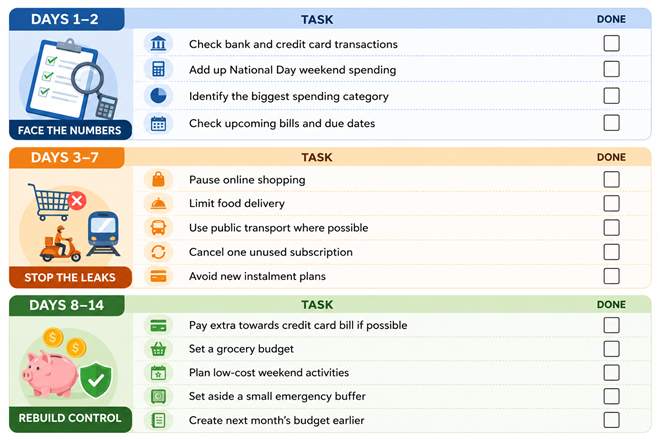
A reset does not need to be dramatic. It just needs to be honest.
12. Prepare Earlier for the Next Holiday or Festive Season
The best way to avoid post-holiday budget stress is to prepare before the next occasion arrives.
Upcoming expenses may include:
- September school holiday activities
- Children’s school expenses
- Deepavali spending
- Year-end travel
- Christmas gifts
- Family gatherings
- Insurance premiums
- Medical appointments
- Home repairs
Create a small “festive and family fund” now.
| Monthly Savings |
Amount After 4 Months |
| S$50 per month |
S$200 |
| S$100 per month |
S$400 |
| S$200 per month |
S$800 |
| S$300 per month |
S$1,200 |
Even a small monthly amount helps reduce pressure when the next spending season arrives.
This is how you stop predictable expenses from becoming “emergencies” with better branding.
A Simple Post-Long-Weekend Budget Checklist
Use this checklist after any expensive weekend:
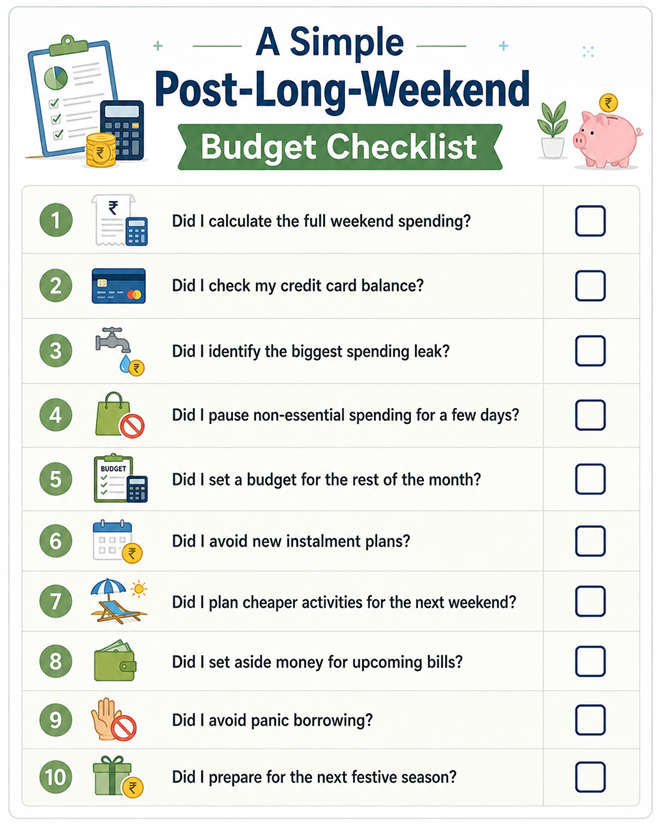
If you tick most of these, you are already back in control.
Final Thoughts
National Day is worth celebrating. The long weekend is meant for memories, family, food, fireworks, and enjoying Singapore’s birthday. But after the celebrations, it is important to reset your budget early before temporary spending becomes longer-term stress.
Start by checking what you spent. Review your credit card balance. Pause non-essential spending for a short period. Build a realistic budget for the rest of August. Use any available payouts wisely. Cut back on the biggest spending leak. Avoid new instalments and do not borrow just to cover lifestyle spending.
A spending hangover is not the end of the world. It is just a signal to reset.
The best financial move after a big weekend is simple: face the numbers, fix the leaks, and move forward with a better plan.
Your wallet may have suffered during National Day, but with the right reset, it can still make a strong comeback. Very Singaporean of it.